The Chroniclers
Appendix M
THE CHRONICLERS OF THE
SPANISH CONQUEST OF PERU
This is a work in progress. Check back for additions.
Chroniclers linked in from the body of the glossary may
not appear here. If a
chronicler's link in the index
below is dead, then I have not yet entered that information.
Index of names
All text and graphics are from Wikipedia unless otherwise indicated.
Those who observed and studied the people of the Tawantinsuyu did us, modern students of this marvellous shamanic cosmovision, a great service because they were excellent record-keepers and wrote everything down. Granted, their perception was greatly stained with religious bigotry; nonetheless, without their scholarly efforts, the love of Pachamama and the expansive abilities in consciousness that we have gained with our studies would not have been possible, at least not in this depth.
I am busy stitching together a more complete picture from myriad sources within this glossary, as are many other scholars within their own venues. The dogged mining of information by modern archaeologists has brought, and will continue to bring, to light valuable nuggets to expand and deepen our own understanding.
FATHER BLAS VALERA
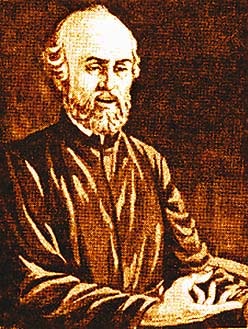
Father Blas Valera
So, let's find out about Padre Valera who, 400 years after his death, is creating quite the firestorm in archaeological circles. I strongly recommend that you read this bio in conjunction with the quipu article entitled Talking Knots of the Inca in Appendix C, as well as the bios of Garcilaso de la Vega and Guaman Poma de Ayala, below. The recommended quipu article and the two bios tell us about an historical soap opera of plagiarism, lies exposed and the possible tipping of a couple of sacred cows. -- Patt
We begin this biographical sketch with the discovery of an old manuscript in an Italian private library that contains startling revelations about Valera, Guaman Poma and the quipu:
In the spirit of justice Blas Valera broke all the rules-and paid with his life. Hundreds of years later, his ghost has returned to haunt the official story. But is it the truth, and will it set the record straight?
This is the tale of Father Blas Valera, the child of a native Incan woman and Spanish father, caught between the ancient world of the Incas and the conquistadors of Spain. Valera, a Jesuit in sixteenth-century Peru, believed in what to his superiors was pure heresy: that the Incan culture, religion, and language were equal to their Christian counterparts.
As punishment for his beliefs he was imprisoned, beaten, and, finally, exiled to Spain, where he [supposedly] died at the hands of English pirates in 1597.
Four centuries later, this Incan chronicler had been all but forgotten, until an Italian anthropologist discovered some startling documents in a private Neapolitan collection. The documents claimed, among other things, that Valera's death had been faked by the Jesuits; that he had returned to Peru; and, intriguingly, while there had taught his followers that the Incas used a secret phonetic quipu -- a record-keeping device of the Inca empire-to record history.
Far from settling anything, the documents created an international sensation among scholars and led to bitter disputes over how they should be assessed. Are they forgeries, authentic documents, or something in between? If genuine, they will radically reform our view of Inca culture and Valera. From www.bibliovault.org/BV.book.epl?ISBN=9780472113538
Father Joan Antonio Cumis begins drafting the document [an old manuscript recently discovered in a private library], writing a few pages in Latin. He tells of the censorship to which Valera was subjected by the Jesuits and of the destruction of nearly all of his writings, many of which were critical of Jesuit policies in Peru. According to Cumis some of these were saved and later given to a noble of Inka descent by Valera. From the Archaeology magazine article mentioned above (given in full in Appendix C).
I am convinced that the news that I am about to put down on record will remain a memorable moment for the Peruvian people, news that was reported to me by the former curaca Mayachac Azuay upon his arrival at Cuzco, when the conquistadores were executing [the Inka leader] Tupac Amaru in 1572. This curaca [a member of the Inka nobility who oversaw the affairs of his lineage group] provided me with a lot of interesting information particularly about the half-breed Father Blas Valera, whom he had known personally. This old and noble curaca knew Blas Valera, who had been a defender and spiritual guide of his people, but the friars contested him because he took sides against the Spaniards who tortured the native Quechua in order to obtain their gold…. Father Valera did not accept those among the priests who had the name of Christ in their mouths but not in their hearts….” Archaeology, Volume 49 Number 6, November/December 1996
The life and work of the priest Blas Valera confirms that truth is stranger than fiction. Recent research published by the Italian peruvianist Laura Laurencich Minelli gives new light on this enigmatic Jesuit mestizo chronicler considered 'politically incorrect' by the official history of Peru. Roberto Ochoa B., La Republica, Peru
[The following text is from an article in La Republica, published in Peru. It is taken from a computer translation of the article from Spanish into English. The original text in Spanish can be read here.]
The Catholic, Apostolic and Roman monopolized western knowledge from the Middle Ages to the Renaissance, managing information prior to censorship, punishing with death any deviation in dogma. This propensity to repress anything that contradicts the official truth moved to the Americas after the conquest and also affected the chronicles that originated in the New World. The Viceroyalty of Peru passed under the iron subjugation and ideological control managed by the dreaded Inquisition.
In 1996, Italian peruanista Laura Laurencich Minelli presented research on the Miccinelli Manuscripts [the manuscript mentioned above] in the IV International Congress of Ethnohistory, held in Lima in June of that year. Laurencich's presentation was based on the enigmatic Exsul Inmeritus Populo Suo Blas Valera, a bilingual manuscript (Latin text and Quechua translation) with color illustrations, quipu, pieces of metal, fabrics prehispanic iconography and even a piece of spondyllus shell . The work was written in the early years of the conquest by the Jesuit priest Blas Valera, tested with paleographical and chemical analyzes by Italian universities, the manuscript is original and corresponds to the dates given in the text. It was sent to Europe in the utmost secrecy in a box that is still preserved in the collection of antiquarian Clara Miccinelli, an Italian lady descended from an old family whose family tree include popes, cardinals, Italian-Spanish nobles and viceroys in America. The document breaks all the schemes of the official story: eyewitnesses saying that Francisco Pizarro captured Atahualpa Inca after poisoning his warlords. Valera also reveals the clandestine activity of a lodge known as The Brotherhood of the Name of Jesus of Cusco, dedicated to exposing the abuses of the clergy and of the conquerors, to claim indigenous-rights after creating a syncretic and "Peruvian" church -- and the restoration of the Inca economy following the precepts of the early Christians.
In Cusco, Blas and other Jesuits formed the Brotherhood of the Name of Jesus, whose activities were uncomfortable for the colonial government. Valera was then accused of breaking his vows of chastity (no details given of the case) and sent to Spain to "regenerate." Valera decides to return to Peru under another name. Here he resumed his contacts with members of the Brotherhood of the Name of Jesus and a group of Spaniards who denied the official version of capturing Atahualpa. According to Blas Valera, and based on testimony from soldiers and others who participated in the capture of Atahualpa, the last Inca was never defeated in battle, but after the poisoning of his principal military chiefs. Blas Valera wrote that the people of Tawantinsuyu were the true owners of Peru. It is then that he decided to write the New Corónica and Good Governance, paying signature Indian Guaman Poma de Ayala for the use of his name "in exchange for a horse and cart."
Garcilaso de la Vega
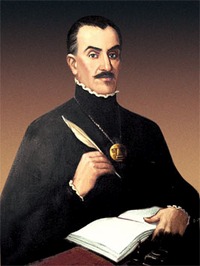
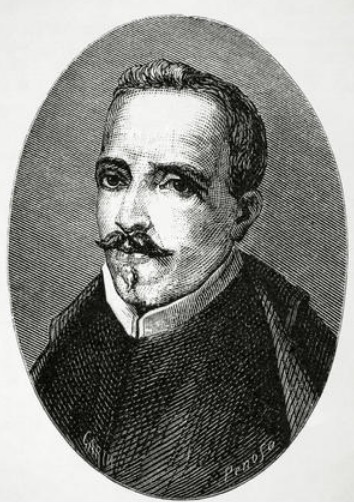
Garcilaso de la Vega
Born Gómez Suárez de Figueroa, and known as El Inca, Garcilaso was a chronicler and writer from the Spanish Viceroyalty of Peru.The son of a Spanish conquistador and an Inca noblewoman, he is recognized primarily for his contributions to Inca history, culture, and society. Although not all scholars agree, many consider Garcilaso's accounts the most complete and accurate available. Garcilaso's mother, Inca princess Palla Chimput Ocllo, was descended from Inca nobility, a daughter of Tupac Huallpa and a granddaughter of the powerful Inca Tupac Yupanqui. Garcilaso lived with his mother the first ten years of his life and learned to speak both Quechua and Spanish. Garcilaso wrote accounts of Inca life, history, and the conquest by the Spanish. His writings were published as the Comentarios Reales de los Incas (translated complete into English in 1961 as The Incas).
Garcilaso accused Blas Valera of plagiarizing and distorting the Comentarios Reales de los Incas in his book Exsul Inmeritus Blas Valera Populo Suo to conform to official censorship. The truth is that Garcilaso himself cites Blas Valera several times in his work, but the Jesuit chachapoyano [Valera was from Chachapoyas] reveals that not only had Garcilaso misquoted and distorted all information related to the quipu as literature by minimizing the quipu to a simple accounting function. According to Valera, Garcilaso did not understand literary quipu and ignored the existence and interpretation of capac quipus. CBVCBV · larepublica.pe/blogs/andares/2013/05/01/el-codigo-blas-valera/
Fray Domingo de Santo Tomás
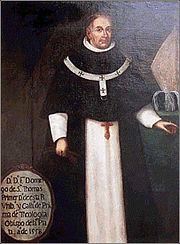
Fray Domingo
A Spanish Dominican missionary and grammarian, he arrived in Peru in 1540 and founded the convent and city of Yungay. For the purpose of evangelization, he learned the Quechua language spoken along the coast near Lima. In 1560 he published his Grammatica o arte de la lengua general de los indios de los Reynos del Perú, the first book printed in Quechua. In the same year appeared his Lexicon, o Vocabulario de la lengua general del PERV. The coastal dialect of Quechua was significantly different than that of Cusco.
Father Diego González Holguín
Diego was a Spanish Jesuit priest and researcher of the Quechua language during the times of the Viceroyalty of Peru. He arrived to Peru as missionary in 1581 and studied the Quechua language during 25 years in the city of Cusco. By 1607, he published in Lima his Grammar and arts of the general language of Peru, a year later the Vocabulary of the general language of the entire Peru, the first dictionary of the Quechua of Cusco. It was the second most important work about the Quechua language. Click here to download a digital image file of Diego's Quechua-Spanish/Spanish-Quechua dictionary (2.7 MB).
Father José de Acosta
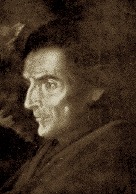
José de Acosta
José de Acosta was a Spanish Jesuit missionary and naturalist in Latin America in the 16th-century. In April 1569, he was sent to Lima, Peru, where the Jesuits had been established in the proceeding year.
He left Spain with several of the Jesuit brethren at age thirty-two in 1570, landing at Carthagena, Panama, then journeyed through 18 leagues of tropical forest. Here he enjoyed the beauties of the glorious scenery, the novel sights at every turn, and was interested in the clever antics of troops of monkeys. From Panama he embarked for Peru in pursuance of his missionary work. He expected, as professed by the philosophers that he had studied, an unbearable intense heat in crossing the equator, but found it to be so cool in March that he laughed at Aristotle and his philosophy.
On his arrival at Lima, he was ordered to cross the Andes, apparently to join the Viceroy in the interior. He took the route, with fourteen or fifteen companions, across the mountainous province of Huarochiri, and by the lofty pass of Pariacaca [over 14,000 ft.], where the whole party suffered severely from the effects of the rarefied atmosphere. Acosta was one of the earliest people to give a detailed description of altitude sickness, a variety of which is referred to as Acosta's disease. He also mentions an attack of snow blindness and the way in which an Indian woman cured him.
The principal seat of the Jesuits was at that time in the little town of Juli, near the western shores of Lake Titicaca. Here a college was formed, the languages of the natives were studied, and eventually a printing press was established. Acosta probably resided at Juli during much of his stay in Peru. It was here, in all likelihood, that he observed the famous comet of 1577, from November 1 to December 8, which extended like a fiery plume from the horizon nearly to the zenith. Here, too, he devoted much of his time to the preparation of several learned works, which he later took back to Spain in manuscript, including the first two books of the Natural History of the Indies.
In 1579, Sir Francis Drake was on the coast, and the Viceroy dispatched a fleet, partly to chase the English pirate and partly to explore and survey the Strait of Magellan. Acosta had conversations with the pilot of Sarmiento's fleet, and was allowed to inspect his chart [pilots of this era were notoriously secretive about their charts], thus obtaining much hydrographic information, and particulars respecting the tides in the straits.
Acosta founded a number of colleges, among them those of Arequipa, Potosí, Chuquisaca, Panama and La Paz. His official duties obliged him to investigate personally a very extensive range of territory so that he acquired a practical knowledge of the vast province and of its aboriginal inhabitants. At the 1582 session of the Third Council of Lima, Father Acosta played a very important part and was its historian. He delivered an eloquent and learned oration at its last sitting on October 18, 1583.
Antonio de Herrera y Tordesillas
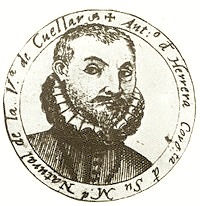
Antonio de Herrera y Tordesillas
Herrera's historiography of the Americas began with his Descripción de las Indias, published in 1601, in which he included various maps and foldout pages. In spite of its being considered an independent work, as that is how it was published, it serves as the introduction to his Décadas, establishing a pattern often imitated by twentieth century writers: he treats the geographical matters in the strictest sense of the word, such that it serves as a helpful tool for understanding the history he would publish subsequently, describing the locations of significant places and the lay of the land as the setting in which the history played out.
The tradition which began with Columbus' first voyage culminated with Herrera's Descripción. It is composed of several chronicles, nautical treatises, and other manuals, as well as extensive cartography. Herrera drew upon all these sources to compose the text of his Descripción and its fourteen maps of the Americas and the Far East. It was common in later editions of his Décadas to include his Descripción as a supplement, although on occasion it was published separately. It was translated into English, by Captain John Stevens in 1725, as well as German, French, and Latin.
Herrera is most widely recognized for his Historia general de los hechos de los castellanos en las Islas y Tierra Firme del mar Océano que llaman Indias Occidentales, known as Décadas, which was published by Juan Flamenco and Juan de la Cuesta between 1601 and 1615, in four volumes. It is the most complete written history of the Americas, and as its title indicates, the work focuses on telling the events experienced by the conquistadors, passing over the natural environment, which he had already covered in his Descripción, and the indigenous world, hence it is a history of events rather than of things. Nor is it a history whose underlying objective was to understand and evaluate events, rather it is fundamentally descriptive, leaving personal judgments to the side, retelling the events in which the Castilians were the main actors.
The Décadas are considered a work not subject to influence, since the author did not live through the experiences he describes, attempting to acquaint the reader with them through the chronicles of his predecessors in his post and other learned men of letters, and through all the official documents which, due to his position, he had within reach, so that it was the first history of the Americas which used all the available historical sources and so was the first general history of the Americas.
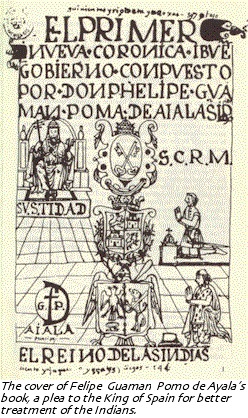
Felipe Guaman Poma de Ayala
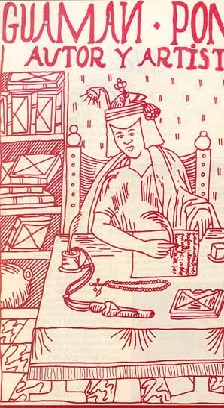
[The following is from Wikipedia and gives current belief about Guaman Poma. Refer to Appendix C and to the bio of Blas Valera, above, to read about a startling new finding that is creating a bit of an uproar in the academic community, especially regarding Poma.]
The son of a noble family from the central Southern Peruvian province of Lucanas, he was a direct descendent of the eminent indigenous conqueror and ruler Huaman-Chava-Ayauca Yarovilca-Huanuco, Felipe Guaman Poma de Ayala was a fluent speaker of several Quechua dialects who probably learned Spanish as a child or adolescent. The information known about Guaman Poma's life comes from a variety of written sources. It is believed that the first time he left his hometown was when he served as an interpreter on a church inspection tour of a Spanish priest named Cristóbal de Albornoz, who was attempting to eliminate idolatries in the small Quechua towns. In the late 1580s to early 1590s, he was an assistant to Fray Martin de Murua, another Spanish cleric. In 1594 he was employed by the Spanish judge of Huamanga who was in charge of land titles. In late 1600, however, all of his property was confiscated and he was banished from Huamanga, an event that led to his travels throughout the country and most likely to the construction of his masterpiece.
A handful of sixteenth-century documents attest that Guaman Poma served in the 1560s-70s as a Quechua translator for Fray Cristóbal de Albornoz in his campaign to eradicate the messianic apostasy, known as Taqui Onqoy, from the Christian doctrine of local believers.
Guaman Poma appeared as a plaintiff in a series of lawsuits from the late 1590s, in which he attempted to recover land and political title in the Chupas valley that he believed to be his by family right. These suits ultimately proved disastrous for him; not only did he lose the suits, but in 1600 he was stripped of all his property and forced into exile from the towns which he had once ruled as a noble.
Guaman Poma's great work was El primer nueva corónica y buen gobierno (The First New Chronicle and Good Government), a 1,189-page document. His book remains the longest sustained critique of Spanish colonial rule produced by an indigenous subject in the entire colonial period. Written between 1600 and 1615 and addressed to King Philip III of Spain, the Corónica outlines the injustices of colonial rule and argues that the Spanish were foreign settlers in Peru. "It is our country," he said, "because God has given it to us." The king never received the document. [Fifty years after Philip received it, the book wound up in the collections of the King of Denmark and forgotten. It was rediscovered in 1908.]
The Corónica is remarkable in many ways. First, it has brilliant melding of writing and fine line drawings (398 pages of the book consist of Guaman Poma's famous full-page drawings). Second, the manuscript expresses the view of a provincial noble on the conquest, whereas most other existing expressions of indigenous views from the colonial era come from the nobility of Cusco. Third, the author frequently uses Quechua words and phrases in this primarily Spanish work, which provided material for scholars to learn more about Quechua.
Guaman Poma proposed a new direction for the governance of Peru: a "good government" that would draw from Inca social and economic structures, European technology, and Christian theology, adapted to the practical needs of Andean peoples. He writes that indigenous governments treated their subjects far better than the Spaniards and pleads with King Phillip to instate Indians to positions of authority. It is important to note that, although he rejects Spanish rule, he does not reject the Spanish king. During that time, monarchs were typically seen as descendants of God and being strongly Catholic, Guaman Poma holds the Spanish monarch in the highest regard. In his writing, he not only wants to propose changes in society, but also to bring perceived injustices to the attention of the king, who, as representative of God, surely would not have allowed them to occur had he known.
Twentieth-century scholars had often speculated that there was some relationship between Guaman Poma's Corónica and Fray Martín de Murúa's Historia general del Piru (1616), assuming that Guaman Poma served as an informant or coauthor to Murúa. In 1967, Condarco Morales compared the texts and concluded that Guaman Poma followed Murúa's work. A direct relationship between Guaman Poma and Murúa was confirmed in 2007-2008 by a project at the Getty Research Institute. These scholars proved that Murúa's chronicle includes illustrations by Guaman Poma. They concluded that Guaman Poma was one of a team of scribes and artists who worked for Murúa. While Murúa's project began sometime in the 1580s, Guaman Poma became involved only as an illustrator and only shortly before 1600. Still, his contribution to Historia general del Piru is very significant.
Guaman Poma notably attacks Murúa in his Corónica, including depicting the friar's striking and kicking an indigenous woman seated at a loom. This image is entitled "The Mercedarian friar Martín de Murúa abuses his parishioners and takes justice into his own hands." According to Rolena Adorno, "...when he became an author, after 1600, [Guaman Poma] was highly critical of a work by Murúa that he had recently illustrated. Guaman Poma was prompted to write his own account against what he understood to be Murúa's limited perspective, which he had encountered in [the original manuscript of Historia general del Piru].
Guaman Poma wrote about Andean history back to the era predating the Inca. He also elaborated a long and highly critical survey of colonial society, unique among other manuscripts of the era. Guaman Poma's artistic range, displayed in his nearly 400 drawings, was based on his experience gained while working with Murúa, but it also developed in new directions. He revealed a strong polemical and satirical bent that he directed against colonial abuses. Although the evidence suggests that they worked independently after 1600, the efforts of Murúa and Guaman Poma can never be separated, and their talents, individually and together, produced three distinctive testimonies to the interaction between missionary author and indigenous artist-cum-author in early colonial Peru.
Fray Martín de Murúa
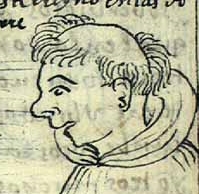
Martín de Murúa, drawn by Guaman Poma de Ayala in Nueva Corónica, 1615 (folio 661v detail). No contemporaneous portrait of Murúa is known; the only surviving image is by his estranged former collaborator.
A Mercedarian friar of Basque origin who, according to Wikipedia, arrived in Peru in the early 1580s and served as a missionary across the Viceroyalty including the Lake Titicaca and Cusco regions. Over more than three decades he compiled Historia general del Piru (c. 1580–1616), considered the earliest illustrated history of Peru. The chronicle is divided into three books covering Inca origins, governance, and colonial Peru, and incorporates indigenous testimony and oral accounts gathered during his missionary travels. He received royal authorization to publish it in Madrid in 1616.
The Getty Research Institute project of 2007–2008 demonstrated that Felipe Guaman Poma de Ayala (above) was one of a team of scribes and artists working under Murúa around 1600, and that several illustrations in Murúa's manuscript were by Guaman Poma's hand. Guaman Poma later became sharply critical of his former employer, and his own Nueva Corónica includes a drawing depicting Murúa abusing an indigenous parishioner.
Juan de Santa Cruz Pachacuti Yamqui Salcamaygua
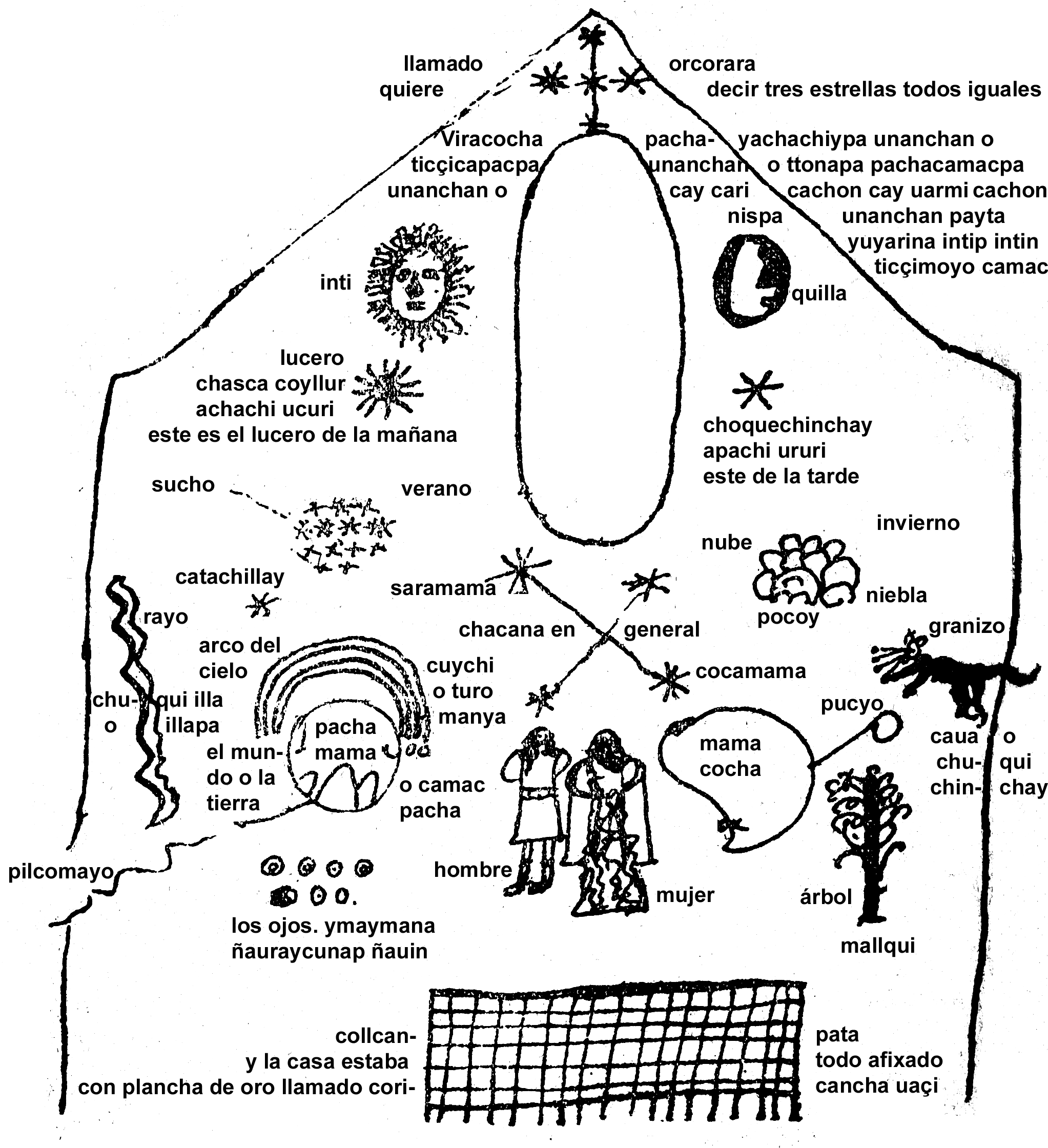
Yamqui's 1613 diagram of the Coricancha cosmology — the only image associated with him on Wikipedia. No portrait of Yamqui himself is known; the figure shown is his own work.
An indigenous (or closely indigenous-aligned) Andean chronicler whose specific dates and birthplace are not documented in available sources. His sole known work, Relación de antigüedades de este reino del Pirú (c. 1613), is brief but is treated by ethnohistorians as having considerable value because it documents pre-Columbian Andean cosmology from a writer with insider access to indigenous tradition.
His most-cited contribution is an annotated drawing produced in 1613 depicting the Inca cosmological worldview, based on imagery from the front altar of the Coricancha and referencing the Inca ruler Pachacuti. The diagram has been the subject of extensive scholarly interpretation as one of the few surviving native attempts to describe Inca cosmology in its own visual terms.
Buenaventura de Salinas y Córdova
A Franciscan friar born in Lima as a criollo (Peruvian-born Spaniard). His Memorial de las historias del Nuevo Mundo Pirú (Lima, 1631) began as a foreword to his brother Diego's life of Saint Francisco Solano and grew into a volume of nearly 400 pages. The text alternates between praise for the virtues and achievements of Peruvians (especially the citizens of Lima) and accounts of colonial abuses he had personally witnessed.
Together with his brother Diego de Córdova y Salinas, also a Franciscan chronicler, his writings are valued as a source on the religious, social, political, economic, intellectual, and cultural life of the Viceroyalty of Peru in the seventeenth century. The work was re-edited in 1957 by Luis Eduardo Valcárcel of the Universidad Nacional Mayor de San Marcos.
Pedro Cieza de León
Known as the "Prince of Chroniclers" (Príncipe de los Cronistas). Cieza traveled to South America around 1536–1537 and participated in expeditions across what are now Colombia, Ecuador, and Peru, helping to establish multiple cities. From 1548 to 1550 he conducted extensive personal research across Peru, returning to Seville in 1551.
His Crónica del Perú is in four parts. He published only the first during his lifetime, in 1553, the year before his death. The second part appeared in 1871, the fourth in 1909, and the third was discovered in a Vatican library and published in 1979. Wikipedia describes his work as fundamental to understanding Inca history because he was the first to consider the structure and organization of the Inca empire; he was also among the few Spanish writers of his era to openly document the population decline caused by Spanish conquest.
Pedro Sarmiento de Gamboa
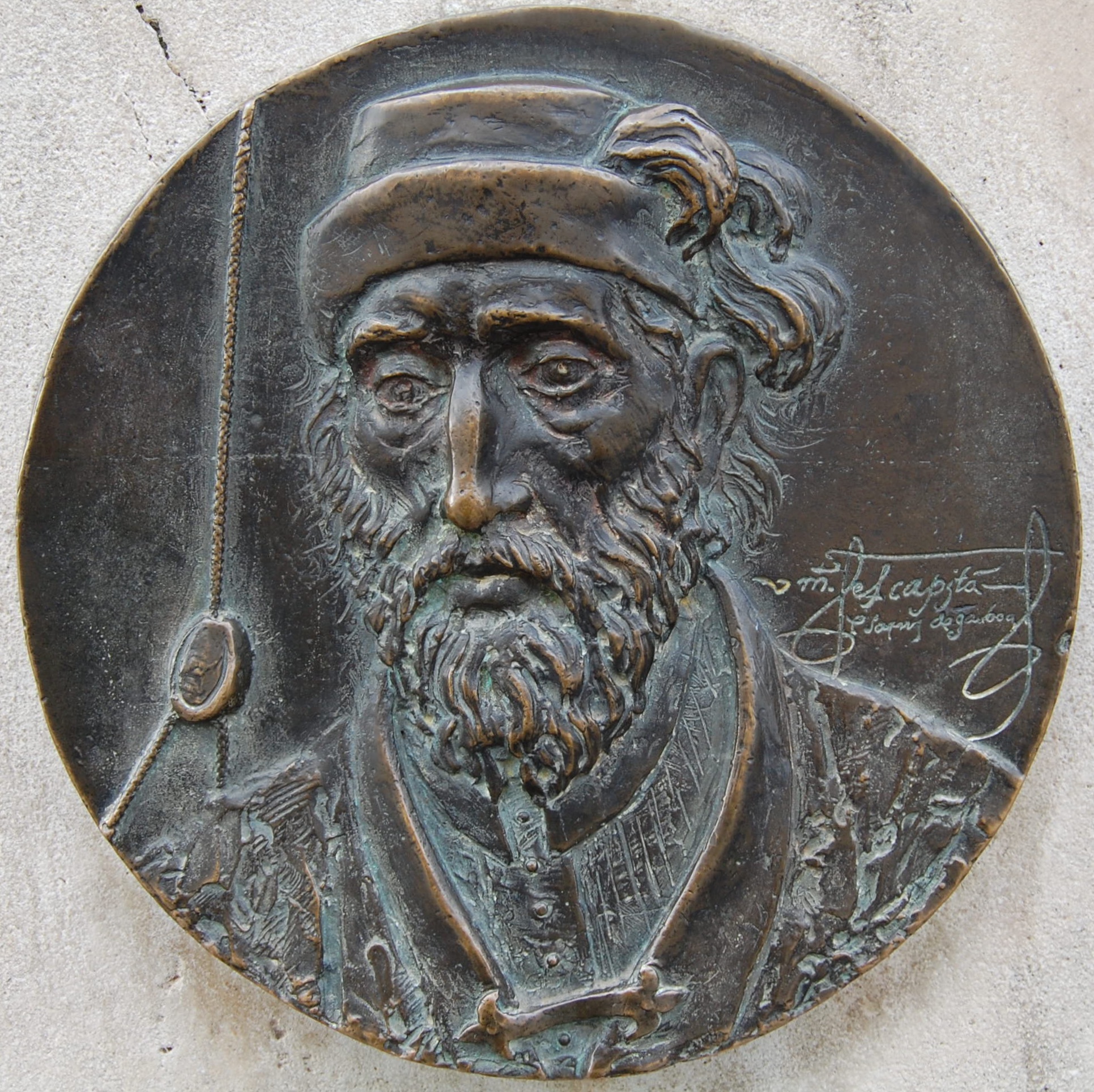
A 2014 photograph of a commemorative depiction of Sarmiento at Alcalá de Henares (Wikipedia). Not a contemporaneous portrait.
In 1572, Viceroy Francisco de Toledo commissioned Sarmiento to write what became the Historia de los Incas. According to Wikipedia, Toledo "hoped such a history would justify Spanish colonisation by revealing the violent history of the Incas." To compile it, Sarmiento interviewed indigenous authorities and Spanish conquistadors in Cusco, gathering oral accounts of Inca history and mythology in detail. He read the finished manuscript aloud to forty-two indigenous leaders for verification before sending it to King Philip II.
Sarmiento was also a navigator and mathematician of consequence. He participated in Álvaro de Mendaña's 1568 Pacific expedition that reached the Solomon Islands, and later explored the Pacific coast of South America and the Strait of Magellan. In 1583 he established a colony there called Rey Don Felipe with 300 men; it failed shortly after. He was captured by English and French forces during the period of the Spanish Armada and died in 1592 near Lisbon while on a naval mission.
Father Joan Antonio Cumis
Cumis is not documented as a person in mainstream historical sources. His name appears attached to one of the manuscripts in the disputed Miccinelli documents, discovered in a private Neapolitan collection and made public starting in 1996. The owner Clara Miccinelli has stated her belief that the texts were written by two Italian Jesuit missionaries — Joan Antonio Cumis and Joan Anello Oliva — between 1610 and 1638. The bound volume, titled Historia et Rudimenta Linguae Piruanorum, contains text in Spanish, Latin, and ciphered Italian.
Per published scholarly summaries, the vast majority of leading specialists of early colonial Peruvian history and literature reject the Miccinelli material as fabrication. A minority position, including the Italian peruvianista Laura Laurencich Minelli, has argued the documents are genuine. If authenticated, they would substantially reshape the picture of Blas Valera (above), the phonetic quipu, and the authorship of Guaman Poma's Nueva Corónica. Until physical tests on the inks and paper resolve the question, "Cumis" remains a name attached to a contested document.
Pedro Pizarro
A first cousin of Francisco Pizarro. Pedro arrived in Peru as a teenage page to the conqueror in 1531 and stayed for the rest of his life. He served as a cavalryman from 1533 onward and was present at the major civil-war battles between Spanish factions — Las Salinas (1538), Chupas (1542), and Xaquixaguana (1548). The crown rewarded his service with land grants and indigenous tributaries in Arequipa, Tacna, and Arica.
His chronicle, Relación del descubrimiento y conquista de los reinos del Perú, was completed in 1571 based on personal observations spanning 1531 to 1555. The original manuscript, held at Spain's Biblioteca Nacional, was lost; a copy survives at the Huntington Library, and an English translation was first published in 1921. The text is valued as the eyewitness account of someone present at the capture of Atahualpa and the events that followed, written by a Pizarro relative who served the household directly.
Father Antonio de la Calancha
A Bolivian-born Augustinian. According to Wikipedia, his family was Andalusian with colonial connections; he took Augustinian vows at fourteen and earned a doctorate in theology at the Universidad de San Marcos in Lima, becoming a notable preacher across the Viceroyalty. He served at assignments in Potosí, Cusco, and Trujillo, where he survived the 1619 earthquake.
His principal work, Crónica moralizada del orden de San Agustín en el Perú, was first published in Barcelona in 1631. While its surface subject is the Augustinian mission in Peru, the chronicle documents indigenous religions, customs, languages, and social structures across Peru and Bolivia. It synthesizes unpublished manuscripts from earlier chroniclers and systematically collects folk beliefs, and is therefore valued as a primary source for pre-Columbian and early-colonial Andean belief systems. His disciple Father Bernardo de Torres completed and expanded the work posthumously in 1655.
Bernabé Cobo Labera
Cobo spent 61 years in Spanish America as a Jesuit missionary and naturalist. His principal work, Historia del Nuevo Mundo, was completed in 1653. Wikipedia describes him as "a most thorough student of nature and man," with unusual access to information through his priestly position and assignments across Peru and Mexico.
For pre-Columbian South America, Wikipedia calls Cobo "a source of primary importance"; only Oviedo's General and Natural History of the Indies compares with the breadth of his treatment of natural history, geography, and ethnography. Patt's Appendix B notes that Cobo personally visited the Island of the Sun in 1616 and recorded what he saw and was told there in detail. The botanical genus Cobaea was named in his honor by the Spanish botanist Cavanilles.
Cristóbal de Molina, "el Cuzqueño"
Two Spanish colonial chroniclers named Cristóbal de Molina worked in early Peru and are routinely confused; this entry covers the one known as "el Cuzqueño." Per Wikipedia, he settled in Cusco in 1556 and became fluent in Quechua. In 1565 he was appointed priest at the Hospital for the Natives, and subsequently served as preacher general of Cusco's parishes and visitor general of the bishopric.
His sole preserved manuscript, Relación de las fábulas y ritos de los Incas, was composed between 1575 and 1576 and dedicated to Bishop Sebastián de Lartaun. Molina compiled it by gathering elderly indigenous men who had personally witnessed and performed Inca religious ceremonies before the conquest, and recording their accounts. The manuscript preserves a collection of prayers and songs in Quechua with Spanish translations, and is among the most detailed surviving sources for Inca religious practices and festivals — including ceremonies like the Capac Hucha.
Father Pablo José de Arriaga
Arriaga was born in Vergara, Biscay, in 1564 and entered the Society of Jesus in 1579. He arrived in Peru in 1585, where he was ordained. According to Wikipedia, he died in 1622 when "his ship and four others were beached and wrecked" during a storm while he was returning to Europe on a confidential mission.
His principal work, La extirpación de la idolatría en el Perú, was completed in 1620 and published in Lima in 1621; an English translation, The Extirpation of Idolatry, appeared later. From 1604 to 1622, Arriaga was instrumental in colonial campaigns to suppress indigenous Andean religious practices. He accompanied official "visitors" including Father Fernando de Avendaño and directed the construction of educational institutions, including a college for the sons of indigenous rulers and a reformatory for indigenous shamans. Modern scholars value the work as a primary source documenting indigenous religion, resistance strategies, and colonial ecclesiastical methods, while also recognising it as a record of systematic cultural suppression.
Bartolomé de las Casas
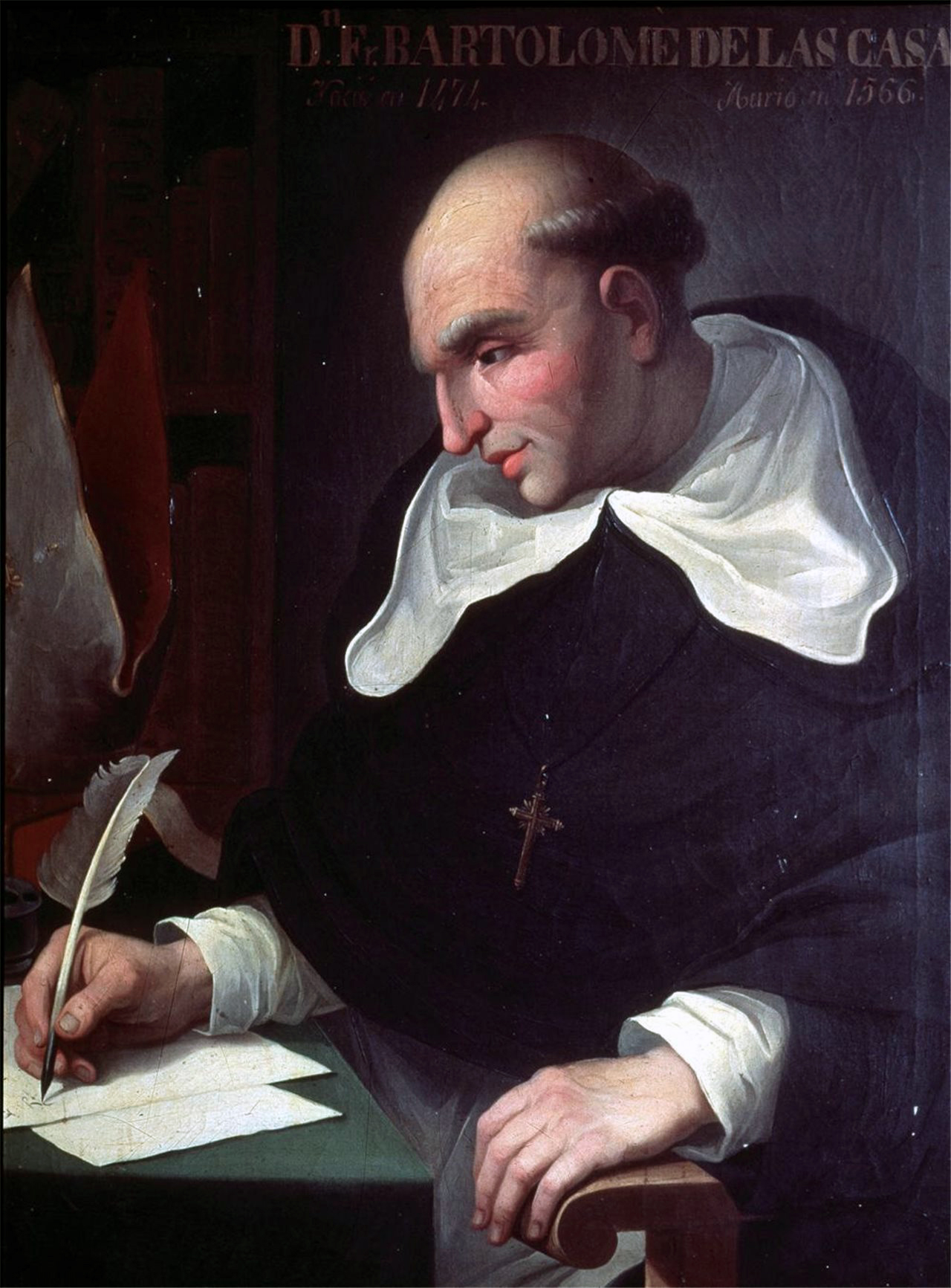
Fray Bartolomé de las Casas (Wikipedia portrait).
Las Casas's direct experience was in the Caribbean and Mesoamerica rather than Peru, but his writings shaped the moral debate every subsequent colonial chronicler navigated. He arrived in the New World in 1502, became a settler and slave-owner in Hispaniola, and underwent a moral conversion around 1514 after studying scripture. He abandoned his encomienda, joined the Dominicans, and devoted his life to defending indigenous peoples against Spanish abuses.
His Brevísima relación de la destrucción de las Indias (1552) documents Spanish atrocities in stark terms and (per Wikipedia) became the founding text of what Spain's enemies would later call the Black Legend. His three-volume Historia de las Indias (completed 1561) is a more sober eyewitness account of colonization. His Apologética historia summaria is an ethnographic defense of indigenous American civilizations.
As the first official "Protector of the Indians" and Bishop of Chiapas (1544–1550), Las Casas campaigned against the encomienda labor system; his testimony directly influenced the New Laws of 1542, which abolished native slavery. In the 1550–1551 Valladolid debate against Juan Ginés de Sepúlveda — who argued that indigenous peoples were "natural slaves" by Aristotelian standards — Las Casas argued for their rights and full humanity. His moral framework profoundly shaped Spanish colonial discourse on indigenous populations throughout the Americas.